Tuesday, February 4, 2020

‘African American Soldiers in Wartime’ Symposium a Success

Keynote speaker Brig. Gen. Gracus K. Dunn, U.S. Army retired,
made the final presentation during the symposium Feb. 1.
A free symposium highlighting the historical contributions of African American soldiers in U.S. wars drew more than 200 people Saturday morning to the Mosaic Templars Cultural Center in Little Rock.

“It was a great symposium” said Ricky Lattimore, a Black History Commission of Arkansas member. “I can’t say enough about the speakers – everything was very informative.”

The event, which kicked off Black History Month, was a joint effort between the Arkansas State Archives and the Black History Commission of Arkansas. Audience members were from all over the state and included military veterans from World War II to present day.

The symposium celebrated the current and historical contributions, actions, bravery and efforts of African Americans during U.S. wars. The event was recorded and will be available online and at the Arkansas State Archives in the future.

Wilbur D. Mills University Studies High School students in the U.S. Army Junior Reserve Officers' Training Corps (JROTC) posted the colors for the symposium.
Speaker Tamela Tenpenny-Lewis presented "Forgotten First: B-1 and the Integration of the Modern Navy," the regimented band that had the first African Americans to serve the modern Navy at a rank higher than messman.

Tenpenny-Lewis is a co-founder and charter member of Preservation of African American Cemeteries, a nonprofit group organized to identity, document and preserve African American cemeteries. She is a genealogist and served from 2012 to 2015 as the national president of Afro-American Historical & Genealogical Society.

Carl Hines, 90, asks Brig. Gen. Dunn
a question during the symposium, which
drew many veterans interested in
Arkansas and military history.
Dr. Cherisse Jones-Branch, a professor of history at Arkansas State University, spoke about her personal experiences as a military veteran of the Persian Gulf War. Her presentation, "A Debutante, a Soldier and a War Veteran," drew a standing ovation after she discussed PTSD, war and emotional impact military life has on families and individuals. She also spoke about the often-overlooked contributions and services of African American women in the military throughout American history.

Jones-Branch, who is a member of the Black History Commission of Arkansas, has accrued multiple honors and awards for her research, studies, mentoring and teaching. She has published several books, including “Crossing the Line: Women’s Interracial Activism in South Carolina during and after World War II,” and is wrapping up a book project about activism among rural black women in Arkansas between 1913 and 1965.

Keynote speaker Brig. Gen. Gracus K. Dunn, U. S. Army retired, made the final presentation, "African-American Services in America's Wars." Dunn discussed the historical timeline of African Americans fighting in U.S. wars, obstacles they faced and breakthroughs they made in integration and fair treatment in the military. He also discussed how African Americans’ service in the military helped break down barriers at home.

Wars Dunn covered included the American Revolution, the War of 1812, the Civil War, World War I, World War II, the Korean War, the Vietnam War and the Persian Gulf War.

Attendees waited in line to take a photo with Brig. Gen. Dunn.
Dunn is a Little Rock native and graduate of Arkansas Tech University. He was commissioned as a transportation officer in the U.S. Army in 1982. His military education includes a Master of Arts in strategic studies from the Army War College. He has served in a variety of military assignments and operations, including two tours at the Pentagon in Washington, D.C.  He has served internationally and commanded soldiers from Company to General Officer level during his career. Dunn, who retired in 2014, is a decorated veteran whose awards include the Army's Distinguished Service, Defense Superior Service and the Legion of Merit awards. 

After the symposium, veterans and other audience members posed with Dunn for photographs. Lattimore said he is in “awe” of the amount of information Dunn gave during his presentation. The symposium was a success, commissioners agreed.


“I just loved it all,” Lattimore said.


Learn about African American History-makers during Black History Month

Poster of Bass Reeves,
created as part of
Black History Month
by MTCC
African Americans have been and are major contributors to Arkansas and its unique history. Early records show African Americans were in the area that became Arkansas as early as 1721.

We recognize the astounding contributions African Americans have made and look forward to making that history readily available. Researchers can find information about African American history in Arkansas, including photographs, in our digital collections at archives.arkansas.gov or can visit us on location to see scrapbooks, photos, records, artifacts and more.

Events celebrating black history and culture will be underway throughout February as part of Black History Month.

The Black History Commission of Arkansas and Arkansas State Archives kicked off the month with a free symposium on “African American Soldiers in Wartime.” The Arkansas State Archives’ traveling exhibit, “Arkansas African American Legislators 1868-1893,” will be on display at the Brackett Library at Harding University from Feb. 3 to 26.

Meanwhile, our sister agency, the Mosaic Templars Cultural Center, has created historical posters featuring prominent African American Arkansans. More events are available on the MTCC Facebook page.

Black History Month is an important time to reflect and celebrate African American history and culture. The celebration began as a one-week event in 1926. By the late 1960s, it had become a monthlong observance on college campuses. President Gerald Ford officially recognized Black History Month in 1976. Since then, every U.S. president has officially designated February as Black History Month.

Make sure to check out the Black History Month posters on MTCC’s website. For more information about African American history in Arkansas or on how to start a genealogy research project, contact the Arkansas State Archives at 501-682-6900 or state.archives@arkansas.gov.

New Accessions in January

"Arkansas Waltz" sheet music

Our new accessions include donations of music scores, a drawing of Winthrop Rockefeller’s “Inner Circle,” church records from McNeil, in Columbia County, Arkansas, and a 1973 atlas of Arkansas. We hold hundreds of thousands of maps, records, artifacts and books. Let us help you start your next research adventure!

Archival Materials
·         Arkansas Law School catalogues, 1949-1950 and 1950-1951, from an anonymous donor.
·         Five Arkansas postcards donated by New Orleans Public Library: Museum of Automobiles-Petit Jean Mountain, View from Talimena Skyline Drive, St. Elizabeth Church-Eureka Springs, Bridge crossing Lake Hamilton and Majestic Hotel, all undated.
·         New Bethel Baptist Church records, records from New Bethel Baptist Church in McNeil, Arkansas, dated 1869-1886 and includes a typed index of member names. The records were donated by Sara Johnson.
·         Road to a Legacy of Education Excellence, final grant report, Curtis H. Sykes Memorial Grant report, includes final grant report, DVDs and two copies of the book published in 2019.
·         Ron Fuller Collection: contains sheet music for the “Arkansas Waltz,” one “Trojan” Little Rock Junior College yearbook from 1938 and one drawing of Arkansas Gov. Winthrop Rockefeller’s “Inner Circle” by Jon Kennedy. Items were donated by Ron Fuller, Arkansas History Commission member.
New Bethel Baptist Church records

·         Black History Commission of Arkansas collection [accretion]: contains one newspaper section-obituary for John Gragg, one copy of the book “Making America Great: Accomplishments and Struggles of African Americans,” a program for the “Elaine Massacre Memorial Dedication” in 2019 and a poem card by J. Chester Johnson. Items were donated by Carla Coleman, chair of the Black History Commission of Arkansas.
·         Arkansas State Board of Barber Examiners records, 2 cubic feet, ongoing record transfer.
·         Arkansas State Medical Board records, 5 cubic feet, ongoing record transfer.

Printed Materials
·         “Humor and Hard Times along Mud Lake Creek: The Story of the Baker Family of Glenwood on the Caddo,” by Russell Baker, published in 2020. The book was donated by the author.
·         Josh Bridges, with the Arkansas Secretary of State’s office, donated: Election Laws of Arkansas and Constitution of the State of Arkansas of 1874, 2015 edition; Election Laws of Arkansas and Constitution of Arkansas of 1874, 2017 edition; Election Laws of Arkansas and Constitution of the State of Arkansas of 1874, 2019 edition; Constitution of the State of Arkansas of 1874, 2012 edition.
·         “Arkansas Review: A Journal of Delta Studies, Vol. 50, Issue 2,” August 2019, was donated by the Friends of the Arkansas State Archives
·         Arkansas State Library donated: Atlas of Arkansas, Arkansas Department of Planning, 1973; Biennial Report of the State Comptroller, 1942 and 1944; and the Financial Report of the Comptroller, 1959-1962.
·         “Genealogical Guide to Research Ancestors from East German and Sudeten German Areas, from German Settlement Regions in Central, Eastern, and Southeastern Europe,” edited by Arbeitsgemeinschaft Ostdeutscher Familienforscher e. V., 1998. The guide was donated by Glenn Mosenthin.
 
Drawing of Winthrop Rockefeller's "Inner Circle" by
Jon Kennedy.

Presenting to the Kiwanis Club of Osceola

NEARA Archival Manager Dr. Fatme Myuhtar-May
was invited to speak Jan. 23 at the Kiwanis Club.

Twenty-two members of the Kiwanis Club, including the Osceola mayor and several judges, gathered Thursday, Jan. 23, at the Riverlawn Country Club to hear Dr. Fatme Myuhtar-May, archival manager for the Northeast Arkansas Regional Archives, deliver a presentation about NEARA and the Arkansas State Archives.

“We were honored to have the opportunity to discuss the services, works and holdings of the Arkansas State Archives and NEARA, both of which are vital for preserving and protecting Arkansas’s collective identity and history,” Myuhtar-May said.

Mayor Sally L. Wilson invited Myuhtar-May to give the presentation during a lunch. Myuhtar-May talked about the collections, services and activities of NEARA, which is a branch of the State Archives. 

Kiwanis Club members were fascinated to learn about the rich holdings of the Arkansas State Archives, especially NEARA’s Arkansas Territory, or pre-1836, records which are part of Lawrence Country Court Records collection.

Among the documents included as examples in the presentation were: A July 1, 1817, summon for Robert Musick to appear in court and answer the charge of perjury; a list of supplies to build a house with piazza in 1820 in Old Davidsonville, Lawrence County, at a cost of $192.45; and the 1819 will of Lawrence Bradly, a Lawrence County resident who left everything to his wife and entrusted her “at her own discretion to give what she thinks proper to my children.” These and other examples of documents, preserved in the Arkansas State Archives, interchangeably evoked the audience’s laughter, wonderment and reflection on Arkansas history and the state’s early residents.

Some members of the Kiwanis Club asked how they could access archival documents and were informed some records can be accessed digitally at archives.arkansas.gov, while others can be viewed onsite at ASA, NEARA or the Southwest Arkansas Regional Archives (SARA,) another State Archives branch.

For people who cannot travel to location, researchers can request records via email or telephone. For example, people looking into family history can email a search request to the Arkansas State Archives and include as much information as they can about a person they are researching. The email could include the person’s name; approximate dates, such as birth date, marriage date and death date; place of known residence; or other details.

Archival staff will search the digital indexes and databases and send the patron a detailed description of archival holdings, including page counts, and associated costs for digital scans or paper copies that the patron may want. Staff can address questions quickly, thanks in part to the detailed digital indexes and finding aids, some of which volunteers have helped create.

“The Arkansas State Archives, NEARA and SARA are indispensable keepers of factual knowledge about Arkansas history and identity – past, present and future,” Myuhtar-May said. “Our Archives are protectors of knowledge and facilitators of access to it. Contact us and let us help you start your next research adventure.”

For more information, contact NEARA at 870-878-6521 or visit Tuesday through Saturday from 8 a.m. to 4:30 p.m. at 11 Seventh St. in Powhattan. Questions may also be sent to Fatme.Myuhtar.May@Arkansas.gov.

Rich Dedmon, Osceola Kiwanis Club's president, poses with Dr. Fatme Myuhtar-May,
NEARA archival manager (center), and Mayor Sally L. Wilson.


Workshop Spotlights Curtis H. Sykes Grants

Funded in part by the Curtis H. Sykes
Memorial Grant Program.

The Black History Commission of Arkansas is accepting applications for Curtis H. Sykes grants and will make a presentation about the grant  upon request.

“The Curtis H. Sykes Memorial Grant Program has helped fund more than 100 projects that have saved or highlighted African American history in Arkansas,” said Tatyana Oyinloye, African American History coordinator for the Arkansas State Archives. “It’s important that we continue to preserve our history because it is part of our collective history and identity. Without this grant, important aspects of Arkansas’s African American history would have been lost or forgotten.”

Oyinloye presented information about the grant program and application process during a workshop this past Tuesday at the Elaine Legacy Center at 313 College Ave. in Elaine, Arkansas. Information at the workshop included an overview of the Black History Commission of Arkansas, which funds the program; criteria for applying for a grant; activities not funded for grants; and how to develop a project budget and budget justification.  The workshop was free and was sponsored by the Phillips County African American Cemetery Association.

More workshops may be presented upon request, Oyinloye said.

Funded in part by the Curtis H. Sykes Memorial
Grant Program.
The Curtis H. Sykes Memorial Grant Program offers grants that provide support for African American historical preservation and public programming projects in Arkansas. The grants are open year-round to individuals and groups.

The most recent grants were approved in November and included three book projects and a play. The grant will help pay for a theater performance of  "Death by Design," which will be at the Mosaic Templars Cultural Center on Feb. 28 and 29. The play is about events leading up to a fire in 1959 that burned down a dormitory and killed 21 boys at the Negro Boys Industrial School in Wrightsville, Arkansas.

The grant also has helped fund major events, such as “A Centennial Commemoration: Historical Contributions of African AmericanPsychologists from Arkansas,” which is planned as part of the 2020 Black History Month Celebration at Philander Smith College on Feb. 28.

The Sykes grant programs has funded more than 100 projects statewide since it started in 1997. Past projects have included historical research, exhibitions, workshops, publications, oral history interviews, documentary films, cemetery preservation and documentation. The maximum amount for the grant is $3,500 per project.

For more information or to set up a workshop, contact Tatyana Oyinloye at 501-682-6892 or at tatyana.oyinloye@arkansas.gov. For information on the workshop in Elaine, Arkansas, contact James White at 870-714-0307.

About 20 people attended a workshop Feb. 4 for the Curtis H. Sykes Memorial Grant
Program. The event was presented by Tatyana Oyinloye, our African American
History coordinator, at the Elaine Legacy Center in Elaine, Arkansas.


Wednesday, January 29, 2020

Wednesday's Wonderful Collection - Lawrence County (Ark.) Drainage District records, MSNE.0089

Swan C. Dowell owned and operated the Dowell Land Company in Walnut Ridge, Arkansas. Due to his involvement with the railroad companies in land development, he was aware of other efforts in the state to make improvements to the land. Dowell participated in the development of two drainage ditches in Walnut Ridge: Village Creek and Lake Pond. Organization of drainage districts required landowners to petition the county courts to place a lien on the lands through a court order. The court order insured that improvement taxes would be paid. Through taxes, bonds, and sometimes federal funds, a series of ditches, sloughs, and levees were built to control flooding as well as to drain the land to be suitable for further development.

This collection contains Swan C. Dowell's personal records of his efforts and actions on the behalf of the Village Creek and Lake Pond Drainage Districts. The records include correspondence, work orders and estimates, legal documents, land records, and financial information.


  • Village Creek Drainage District 1905-1912 (Box 1)
  • Lake Pond Drainage District #17 1910-1920

Monday, January 6, 2020

A Conversation with Stephanie Carter

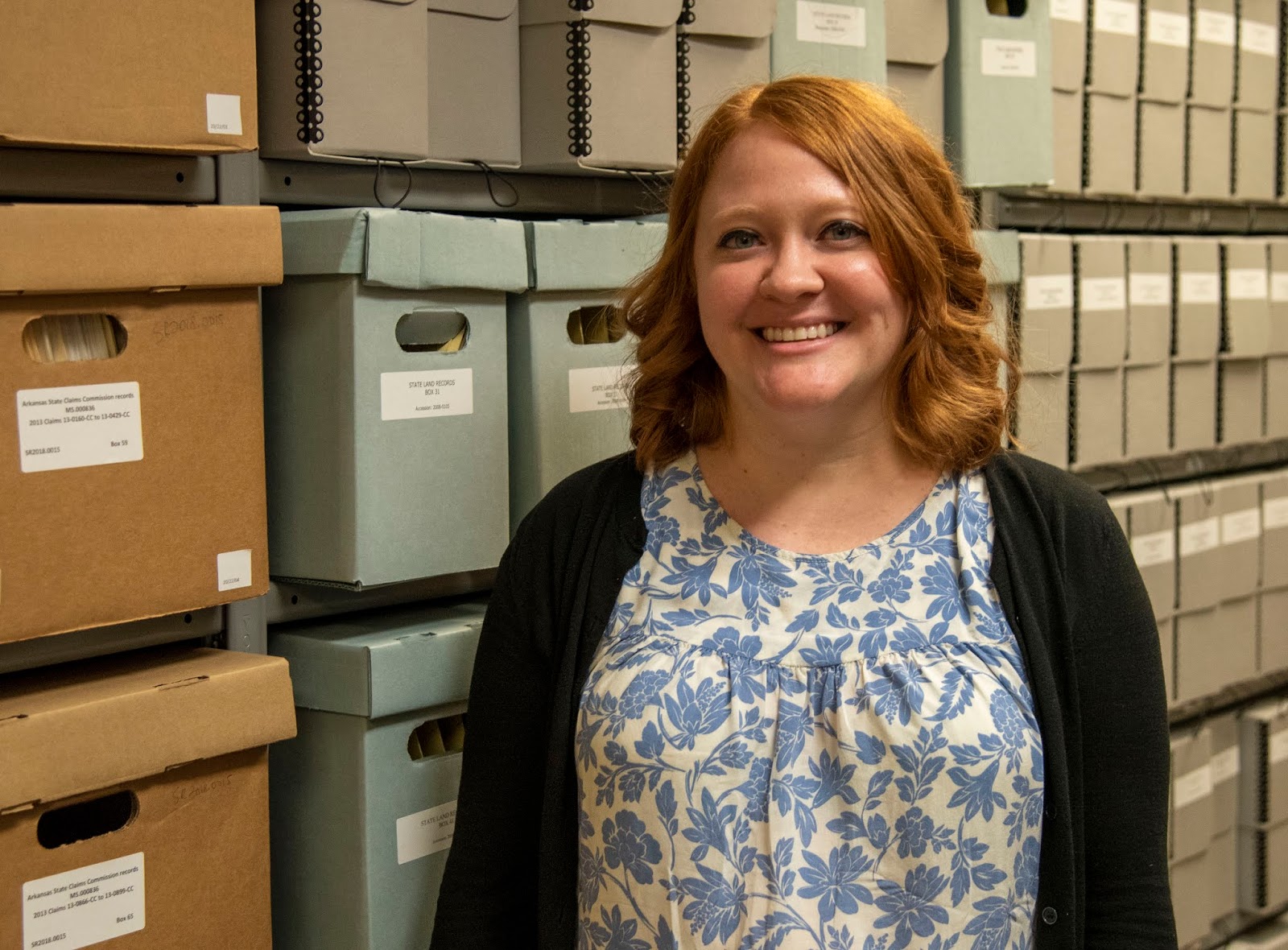
Stephanie Carter, archivist at the Arkansas State Archives
Stephanie Carter, an archivist at the Arkansas State Archives, processes, describes and documents our archival collections on a daily basis while also helping Arkansans research their histories. Carter records the chain of custody, donor information and storage locations of historical materials brought to the Arkansas State Archives. She is instrumental in making sure our collections are well-preserved, inventoried and accessible to the public. Before joining the staff in March 2018, Carter earned a bachelor’s degree in journalism in 2006 and a master’s degree in library and information science in 2014. Her other experience includes work for the Arkansas State Library and New Mexico State University. Carter took a moment from her busy work schedule to answer a few questions.

Q: What do you do on a typical day at Archives?
A: I wear many hats, so my duties for any given day vary. Some days, I work with donors to accept new donations to our Archives. I make a record that includes the donation information and get the historical material ready for processing.

Other days, I visit state agencies to discuss a transfer of records or pick up a collection of records that have been transferred. We also meet with county officials to provide recommendations about the preservation of county records. We continue to microfilm county records, which will create a record that can last over 500 years.

Also, I work in the research room and help our patrons find resources for research projects, such as researching their family histories or finding certain maps or newspaper articles. I spend the rest of my time processing archival collections, which includes organizing records and creating finding aids to help researchers navigate and access materials in our holdings. I also research records and write historical information about the collection.

Q: How did you become interested in Arkansas history or working at the Arkansas State Archives?
A: I have had an interest in Arkansas history for as long as I can remember. I visited museums at a young age and watched my grandmother collect and research our family history. Ever since I learned about the Arkansas State Archives, I have thought it would be an interesting place to work. After college, I worked at a library and eventually returned to school for a master’s degree in library and information science. While I was getting my second degree, my interest in archives grew because I learned more about what archivists do and spoke with people who work in the archiving field. It’s an amazing honor to be part of a team that celebrates and preserves Arkansas history the way the Arkansas State Archives does.

Q: What’s the most important or interesting thing you’ve discovered while working at Archives? Why?
A: I come across so much unique material every day that it’s hard to pick one thing that is the most interesting or important. Arkansas has a long and culturally significant history that is unique and fascinating. Before working at the Arkansas State Archives, I didn’t know what an enormous collection of historical materials the State Archives holds. I also didn’t realize what a wide-array of topics the State Archives covers. We hold more records on Arkansas history than anywhere else in the world. Our collections are phenomenal and range from the Arkansas Territory to modern times. I am constantly learning something new.

Q: Why do you think the Arkansas State Archives is important for Arkansans?
A: I think the Arkansas State Archives is important because it records the state’s history, particularly by preserving unique, primary sources. These historical materials offer a view of Arkansas history that is more than can be read about in a book. Our materials tell the stories of the lives of individual Arkansans in their own words and as they experienced it. We have diaries, letters and photographs that provide a glimpse into what life was like for these individuals.

Q: What is the most rewarding part of your job?
A: There are many parts of my job that are rewarding, but I think the most rewarding part is being able to make our resources available to the people of Arkansas. Whether I’m in the research room helping patrons find information, or I’m preserving and processing collections, it’s important to me to be able to help provide access points to our collections. It’s very rewarding to know a collection is available for use and will be preserved for future generations because of the work I do.

Q: How do you see archiving evolving in the future?
A: One of the biggest factors affecting archives right now is digitization, and we eventually will have more collections available for viewing on our website. This is a very time-consuming task, and I think a large part of our work in the future will be making the difficult decisions of what to digitize first. Digitization has also begun to affect us in other ways. We are receiving more collections in “born-digital” format and in formats that are becoming obsolete, such as floppy disks and VHS tapes. Some of these materials, including VHS tapes, deteriorate quickly, too. We will have to continue to find ways to preserve the materials and transfer them to usable formats. I think the technological ways people access information will continue to evolve, so archivists must adapt to those changes.

Q: What do you wish people knew about Archives?
A: Many people I’ve met don’t know where we are located or what we do. I wish they knew what a large collection of resources we hold and that we are here to help them. We can help with a variety of research needs, including finding genealogy resources, governors’ papers, state records, court records, photographs and more.

For more information about the Arkansas State Archives or research services, visit archives.arkansas.gov, email state.archives@arkansas.gov or call 501-682-6900.