Monday, January 6, 2020

New Employees Join ASA


New employees Kimberly Sanders, left, and
Abbie Deville, courtesy of the Arkansas State Archives
Arkansas State Archives recently welcomed new employees Kimberly Sanders and Abbie Deville! Two other positions will be filled shortly.

“We are thrilled to welcome Kim and Abbie,” said Julienne Crawford, interim director. “Their talent, skill and experience stand out and will be instrumental in our ongoing effort to preserve historical material and increase access to our collections.”

Kimberly Sanders was hired as an archival assistant for the Microfilm Department on Oct. 21. She had held a contract for work at the Arkansas State Archives for the past six weeks before taking the full-time position. Sanders has a bachelor’s degree in art history from the University of Central Arkansas and a master’s degree in art history from the University of Arkansas at Little Rock. 

She previously served as the assistant curator of exhibitions at the Historic Arkansas Museum and as a confinement site interpreter at the Butler Center for Arkansas Studies, where she developed exhibits and published a book on their collections related to Japanese internment camps. She presented lectures on “The American Dream Deferred: Japanese American Incarceration in World War II Arkansas” in 2017, 2018 and 2019. Her publications include: “The Art of Living: Japanese American Incarceration Artwork in the Collections of the CALS Butler Center for Arkansas Studies,” 2019, with the Butler Center for Arkansas Studies, and “Coalescence in Confinement: Cultural Synthesis and Identity in Michi Tanaka’s Community Life,” 2013.

Abbie Deville started Oct. 28 as a digital archivist. She has a bachelor’s degree in history and a master’s degree in public history from the University of Louisiana at Lafayette. Deville focused her studies on digital archival collection management and worked in collections at Mosaic Templar Cultural Center and the Central Arkansas Library System, Dee Brown Branch. She also worked with archives, museums, and the National Park Service in Louisiana prior to moving to Arkansas. Deville is working on expanding the digital collections and preservation of electronic records at the Arkansas State Archives.

Also, applications for another archivist and assistant archivist are under review and will be filled shortly. The two temporary positions are funded by a grant from the National Endowment for the Humanities and are full-time positions that end in August 2021. The positions are related to the Arkansas Digital Newspaper Project, which aims to digitize 100,000 pages of Arkansas newspaper pages for the Chronicling America website.

The website is open-source and is a joint effort by the National Endowment for the Humanities and the Library of Congress. The project for the Arkansas State Archives was originally funded for a two-year cycle in 2017, which was renewed last year. In May 2019, about 40 Arkansas newspaper titles, or about 100,000 pages were sent to the Library of Congress to go online. More are expected to be sent off this year.

The National Digital Newspaper Program started in 2005 and is a nationwide effort that includes 48 states and two territories. Thanks to the project, about 15 million newspaper pages available online for historical research.

New Accessions in December

New accessions for December 2019
Our new accessions include donations of three ledgers and one abstract of title to add to the J.E. Little Plantation records, historical postcards and indexes to death records! We hold hundreds of thousands of records, microfilms, ledgers and books to help you trace your family’s story! Visit us and find your Arkansas roots.
Archival Materials

·         Grace Jones Hays postcard and photograph collection, 10 postcards and 21 photographs of various locations around Arkansas, taken by the donor’s mother and grandmother, Grace Jones Hays, during vacations to Arkansas around the 1950s. Donated by Tammy Vanveckhoven, 0.05 cubic feet
·         J.E. Little Plantation records (accretion to existing collection), donated by Lucy Sogandares. Three ledgers and one abstract of title, 0.25 cubic feet. This collection contains materials pertaining to John Elijah Little, his family, their farm in Faulkner County, and their property and house in Conway, Arkansas.
·         Arkansas Pollution Control and Ecology Commission records (accretion to existing collection), transferred by Patricia Goff, Arkansas Pollution Control and Ecology Commission, 10 boxes of cassette tape recordings of meetings, one box of meeting minutes and one box of maps, 6 cubic feet
·               Neva Boatright Arkansas State Parks collection. Artifacts and archival material related to Arkansas State Parks collected by Neva Boatright during her time working at Petit Jean State Park, Cane Creek State Park and the Lower White River Museum in Des Arc.
·               Joseph D. Bryan postcard collection. A collection of 34 postcards of various locations around Arkansas collected by Joseph D. Bryan, father of the donor, Sue Fourke. Bryan was in the CCC, Army and the Air Force. 

Printed Materials

Donated by Robert Franks:
·         Spartanburg County, South Carolina, will abstracts 1787-1840, compiled by Brent H. Holcomb, C.A.L.S., 1983
·         “Gone to Georgia: Jackson and Gwinnett Counties and Their Neighbors in the Western Migration,” compiled and with an introduction by William C. Stewart, 1979
·         “Pioneers and Residents of West Central Alabama Prior to the Civil War,” by Madge Pettit, 1988
·         “Old Sussex County Families,” by Charles Edgar Stickney, 1988
Donated by Friends of the ASA:
·         Death Records from the Mena Star, Volume 14, 1935-1940
·         1987 Obituaries, Polk County, Arkansas
·         Obituaries from the Mena Star, 1988-1989
·         Death Records from the Mena Star, Volume 11, microfilm roll no. 11, June 2, 1927-February 13, 1930
·         Death Records from the Mena Star, Volume 12, microfilm roll no. 12, Feb. 20, 1931-Dec. 1, 1932
·         Death Records from the Mena Star, Volume 13, microfilm roll no. 13, Dec. 8, 1932-Nov. 14, 1935
·         Death Records from the Mena Star, Volume 5, microfilm roll no. 5, May 13, 1909-May 23, 1912
·         Death Records from the Mena Star, Volume 6, microfilm roll no. 6, May 20, 1912-April 13, 1916
·         Death Records from the Mena Star, Volume 10, microfilm roll no. 10, Feb. 5, 1925-May 26, 1927

‘African American Soldiers in Wartime’ Symposium Set for Feb. 1


LITTLE ROCK –  The Black History Commission of Arkansas is pleased to present “African American Soldiers in Wartime,” a free, one-day symposium about the history of African Americans serving in U.S. wars. The symposium is co-sponsored by the Arkansas State Archives.

The symposium starts at 10 a.m. Saturday, Feb. 1, at the Mosaic Templars Cultural Center at 501 W. Ninth St. in Little Rock. Check-in begins at 9:15 a.m. Tickets are free and available at http://archives.arkansas.gov or via Facebook. 

Speakers Dr. Cherisse Jones-Branch, a Persian Gulf War veteran, will present "A Debutante, a Soldier and a War Veteran," and Brig. Gen. Gracus K. Dunn, who retired from the U.S. Army, will present "African-American Services in America's Wars." The symposium will focus on the contributions of African American soldiers in American wars.

Wilbur D. Mills University Studies High School students in the U.S. Army Junior Reserve Officers' Training Corps (JROTC) will post the colors.

Dr. Cherrise Jones-Branch
Jones-Branch is a military veteran and a professor of history at Arkansas State University. Her research interests include the history of Arkansas and issues related to race and gender, civil rights, rural history, women and African Americans. Jones-Branch, who is also a member of the Black History Commission of Arkansas, has accrued multiple honors and awards for her research, studies, mentoring and teaching. She is a fascinating public speaker who has published multiple books, including “Crossing the Line: Women’s Interracial Activism in South Carolina during and after World War II.” She is researching a project about the activism of rural black women in Arkansas between 1913 and 1965.

Brig. Gen. Gracus K. Dunn,
U.S. Army retired
Dunn is a Little Rock native and graduate of Arkansas Tech University. He was commissioned as a transportation officer in the U.S. Army in 1982. His military education includes a Masters of Art in strategic studies from the Army War College.

Dunn has served in a variety of military assignments and operations, including two tours at the Pentagon in Washington, D.C.  He has served internationally and commanded soldiers from Company to General officer level during his career. Dunn, who retired in 2014, is a decorated veteran whose awards include the Army's Distinguished Service, Defense Superior Service and the Legion of Merit awards. He is a renowned public speaker and an expert on the history of African Americans in the military.

Teachers can earn up to three professional development credits by attending the symposium. The event is free but reservations must be made by Jan. 27. Refreshments will be provided.

This event is presented by the Black History Commission of Arkansas, which is an advisory board of the Arkansas State Archives.

Donated Family Bible Spotlights Two Families, African American History

The Nance Family Bible, donated to SARA by George Wishart

A family Bible recently donated to the Southwest Arkansas Regional Archives, a branch of the Arkansas State Archives, contains vital genealogical information about enslaved African Americans and two families who migrated to Arkansas from Virginia, Alabama and Georgia.

“This Bible is a significant, historical record that will help families discover and trace their family roots in Arkansas,” said Melissa Nesbitt, archival manager. “We are honored to be able to preserve, protect and make available to the public this remarkable resource.”

The Nance Family Bible contains names and birth, marriage and death dates related to the Nance and Clark Families. The families migrated from the southeast and settled in northeastern Texas before moving to southwestern Arkansas.

The Bible was donated to the Southwest Arkansas Regional Archives by George Wishart of Plano, Texas.

The Bible lists African American names and birth dates, which is helpful for genealogical research for African Americans. Researchers often run into obstacles when tracing African American families before the U.S. Civil War. African American families often were not recorded with birth or death records. After the Civil War, families also sometimes changed their surnames.

Some research services and records about African Americans in Arkansas are available at SARA and at the Arkansas State Archives. For example, the State Archives houses records from Hempstead County that list the names of enslaved people as “property” in historical circuit court records dating back to the Arkansas Territory.

The Bible was published by the American Bible Society in 1841, which is during the time when Francis Scott Key, writer of the “Star Spangled Banner,” was vice president of the society. However, the family records listed in the Bible date back prior to the publishing date. Likely, the information was recorded in the Bible after it was published. One page in the Bible reads: “a true copy from the old family Bible.”

For more information about the Bible or other historical records at the Southwest Arkansas Regional Archives, call 870-983-2633 or email melissa.nesbitt@arkansas.gov. More information about Arkansas history and genealogical research is available at the Arkansas State Archives at archives.arkansas.gov or by calling 501-682-6900.

Research Tips: Marriage and Divorce Records

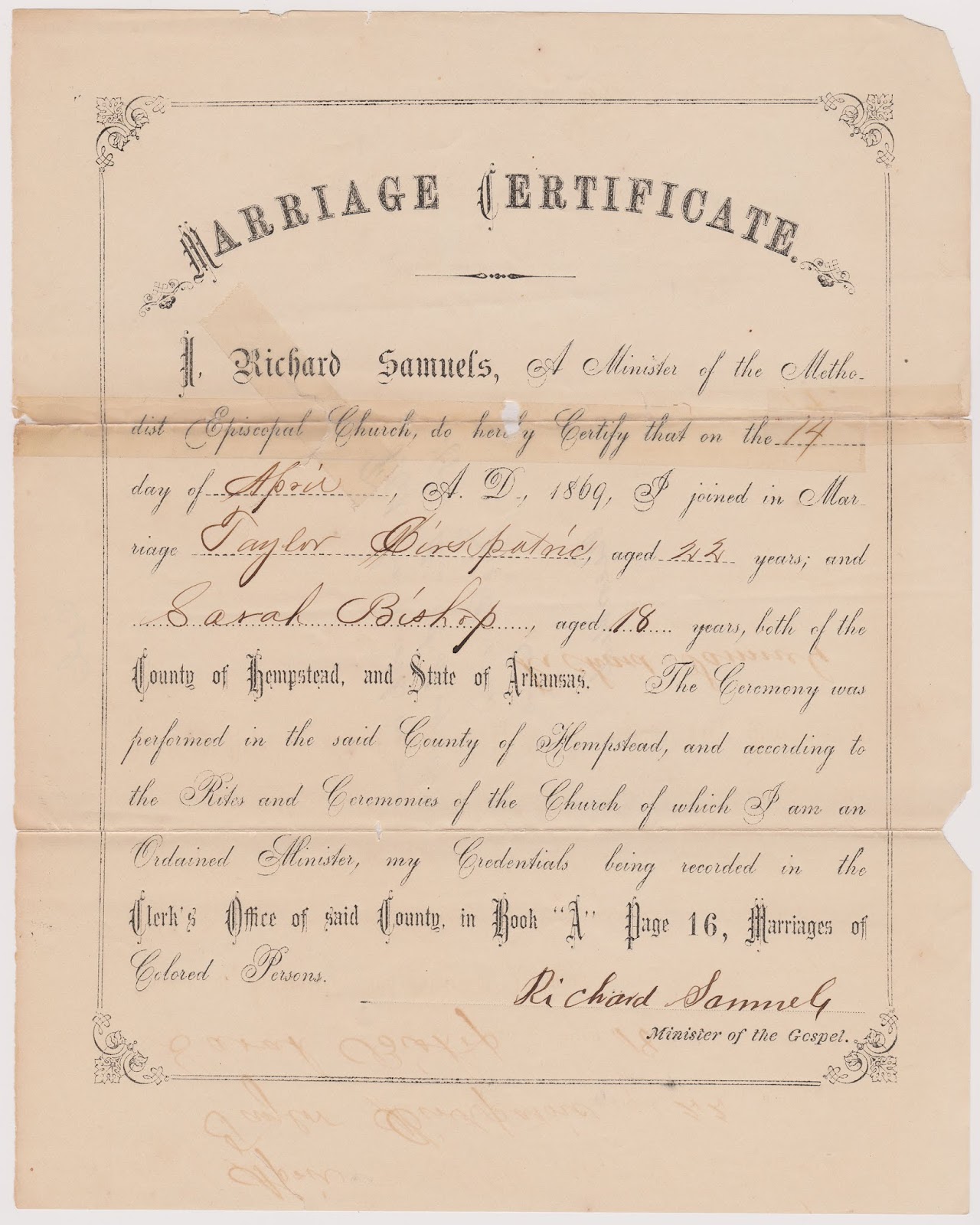
Marriage license for Taylor Kirkpatric and
Sarah Bishop in Hempstead County, 1869,
Southwest Arkansas Regional Archives
Researchers frequently ask: “How can we find marriage and divorce records – especially divorce records?” These documents give researchers vital clues about their ancestors’ lives, but finding out where they are located can be tricky.

Arkansas marriage records are filed in county courthouses and recorded in each county’s own designated book. Arkansas has 75 counties, but some counties have more than one courthouse or county seat. The task may seem daunting, but there are a few indexes that will help.

The Arkansas State Archives has printed marriage indexes available for many counties. The Archives also hold marriage records from all 75 counties on microfilm. Arkansas vital records also produced a marriage index on microfiche, but it only covers 1933 to 1939.

In Arkansas, county marriage records do not include parents’ names or dates of birth for the individuals getting married. Some states, like Ohio, do include this information. Arkansas’s records, however, will give you the residences of the individuals getting married and their ages. If one of the people getting married is underage, researchers can sometimes find a note attached from the parents or guardians that gives the couple permission to wed.

Marriage records can provide the foundation to interesting backstories. For example, if you find a note “do not publish” written on the license, it means the couple didn’t want the marriage announced in the newspaper. Sometimes couples even went to different counties to avoid people knowing they were getting married. Finding those records can reveal aspects about your relatives’ lives you never knew.

If you can’t find a marriage record in the county you think your ancestors married in, you might look in newspapers. Many local newspapers published names of people who took out marriage licenses in the county. The Arkansas State Archives holds thousands of rolls of microfilm from newspapers across Arkansas, and the odds are good you can find one for the area you’re researching.

Some newspapers ran articles on recent engagements and marriages. You might find a blurb about your ancestors getting married, the dress she wore or other information. That information can lead you to find out where they wed and if a license was applied for in a different county.

Lastly, you might check church records for a mention in the minutes or register. The Arkansas State Archives keeps hundreds of church minutes, registers, rolls and more in its archives. These records can be found in a resource guide on our website at http://ahc.digital-ar.org/cdm/singleitem/collection/p16790coll13/id/297.

Divorce records can be a little trickier to find. Divorce records are also filed at a county level. Generally, divorce records are filed in chancery or civil courts unless, like in Pulaski County, they have designated a specific book for divorces. Divorce records are county records, but on occasion, you may have to look at circuit court records to find them.

Early divorce cases are somewhat rare, but they did happen. In Arkansas, women could not file for divorce. On some records, you will find the words: “on her account or her friend,” which means a male filed for her. Later, in the late 1800s, women could and did file on their own account.

After finding when the couple divorced, the next step is to look at the loose court records, if they exist. These records will have all the trial transcripts filed to justify the dissolution of the marriage. Many of the early county records are available on microfilm at the Arkansas State Archives. For more modern divorce records you may need to contact the county courthouse or search through online databases such as the Administrative Office of the Courts CourtConnect website at https://caseinfo.arcourts.gov/cconnect/PROD/public/ck_public_qry_main.cp_main_idx

For many researchers trying to narrow down when a divorce happened can be a challenge. Many of these records have indexes at the beginning of the county records, but if you can’t find information there, you can again turn to newspapers. In the same section where the marriages are published, newspapers often listed divorces. You can eliminate counties by browsing through the areas you suspect the divorce took place. However, there is a small chance the divorce wasn’t published.

Next month, we will look at wills and probate records and how to use them in your research.

Researchers who need help can contact our staff. We are here to provide some research services and to help individuals start their genealogical research. Find more information about our services by contacting the Arkansas State Archives at 501-682-6900 or start researching by visiting our website. Researchers may also find records online through our online catalog.


David Ware Named Director of the Arkansas State Archives

Dr. David Ware

LITTLE ROCK — Stacy Hurst, secretary of the Arkansas Department of Parks, Heritage and Tourism (ADPHT), recently named Dr. David Ware as state historian and director of the Arkansas State Archives!

“Dr. Ware is very familiar with Arkansas history, particularly its political history,” said Mr. Jimmy Bryant, the newly named director of the Division of Arkansas Heritage and former Arkansas History Commission member. “We are lucky to have his talents.”

Ware has served since 2001 as the capitol historian in the Arkansas Secretary of State’s Office. He will begin work as the Arkansas State Archives director on Jan. 21.

Ware earned a B.A. in French literature from the University of Nebraska, an M.A in history from the University of Wyoming and a Ph.D. in U.S. history from Arizona State University. Prior to his service as the state capitol historian, he was an archives assistant at the University of Arkansas, Little Rock; project historian at Cheyenne Frontier Days Old West Museum in Wyoming; and curator of exhibits and collections at Western Heritage Center in Billings, Mont.  He has written articles and reviews for publications such as the “Journal of Arizona History” and the Encyclopedia of Arkansas. His work includes the book, “It’s Official! The Real Stories Behind Arkansas’s State Symbols,” which was published by the Butler Center for Arkansas Studies in 2015.

He has represented the Secretary of State on the board of the Historic Preservation Alliance of Arkansas since 2001 and is a board member of the Arkansas Supreme Court Historical Society. Other memberships include the Arkansas Historical Association, the Arkansas Museums Association and the Society of Southwest Archivists.

While serving as the capitol historian, Ware collaborated on numerous projects with the Arkansas State Archives to preserve state records and exhibit the collections of the Arkansas State Archives at the State Capitol. He has a great knowledge many facets of Arkansas history and the preservation of archival and artifact collections.

“Dr. Ware’s educational background and his tenure with state government make him well-suited to lead the Archives,” said Hurst. “As state capitol historian, he has already worked with many of the ASA staff, and that collaboration will continue in full as they work together to preserve our important historical records.”

Dr. Ware replaces former Director Dr. Wendy Richter who retired in August.


Wednesday, December 4, 2019

Wednesday’s Wonderful Collection - Centennial Missionary Baptist Church records, MG.00486


Centennial Missionary Baptist Church in Helena, Phillips County, Arkansas, was established on July 4, 1876. In August 1876, Reverend Robert Caver of Alabama was called to serve as the first pastor. Caver was followed by two other pastors who served brief periods. However, the church flourished under the administration and pastorate of Elias Camp Morris (1855-1922), who was called in June 1879. Morris later became a leading religious figure in the state and throughout the country. He was a founding member of the National Baptist Convention, and its president until his death in 1922. Morris served as pastor of Centennial for forty-three years.
Centennial Missionary Baptist Church with its Gothic Revival design was listed as a National Historic Landmark on July 31, 2003. The church, located at York and Columbia Streets, was built in 1905 by Henry James Price, an African American architect. Due to major deterioration of the structure, the congregation held its last worship service in 1999. The building still stands, however, and is owned by the E.C. Morris Foundation, comprised of former church members.
The documents in this collection were rescued by Phyllis Hammonds of the E.C. Morris Foundation, and her mother Thelma, who stored the records at the Delta Cultural Center, in Helena, Arkansas. The microfilming of the collection was part of a project made possible with a grant from the Arkansas Humanities Council and Black History Advisory Committee (now the Black History Commission of Arkansas).
The collection contains church programs, correspondence, minutes, financial reports, membership rosters, Women's Missionary Society, Sunday school, and Baptist Young People's Union records.
·         Administrative records
o    1. Correspondence, 1909-1947 (Reel MG00486)
o    2. Minutes, financial reports, etc., 1876-1983
o    3. Membership register, 1941-1955
o    4. Funeral programs, 1965-1991
o    5. Church anniversary celebrations, 1919-1991 (Reel MG00487)
o    6. Special program events, 1931-1997 (includes program of the eighty-second annual session, National Baptist Convention, Incorporated, 1962 September 4-9, Chicago, Illinois)
o    7. Harvest homecoming, 1954-1989
o    8. Reverend A.L. Woodson, personal papers (correspondence, receipts, and membership certificate to The Most Worshipful Sovereign Prince Hall Grand Lodge, Free and Accepted Masons, Jurisdiction of Arkansas, 1947)
·         Women's Missionary Society ledgers
o    1912-1939
·         Baptist Young People's Union, record and roll book
o    1900-1924
o    1924-1941 (Reel MG00488)
o    1940-1973 (Reel MG00489)
·         Sunday school reports, minutes and record books
o    1900-1919 (Reel MG00490)
o    1919-1932 (Reel MG00491)
o    1932-1942 (Reel MG00492)
o    1942-1953 (Reel MG00493)
o    1954-1970 (Reel MG00494)
o    Sunday School records, 1971-1984 (Reel MG00495)
o    Class books, 1917-1947